Knotless vs. Box Braids: Which Is Better for Your Hair?
Compare knotless and traditional box braids by root tension, weight, installation, longevity, budget, upkeep, and the look you want.

· 16 min read
On this page
Knotless braids are usually the better first choice when scalp comfort, a flatter root, and easy movement matter most. Traditional box braids are often the better choice when you want a more structured base, a faster appointment, and roots that may stay defined longer. Neither method is automatically gentle or damaging. Braid size, added-hair weight, length, edge tension, and the braider's technique matter more than the label.
If your scalp is sensitive or your edges are fragile, start with medium or large knotless braids, modest length, and less extension hair. If you value a crisp, raised root and want a style that resists early root frizz, traditional box braids may suit you better, provided the base is not installed tightly.
Key takeaways
- Knotless braids begin with your natural hair, then add extension hair gradually. Traditional box braids usually secure extension hair at the root before braiding down.
- Knotless roots tend to lie flatter and move more freely right after installation.
- Traditional box braids often have a firmer, more defined base and may look neater at the root for longer.
- "Knotless" does not mean tension-free. Either method can pull if the sections are too small, the braider grips too tightly, or the extensions are too long and heavy.
- Pain, stinging, scalp tenting, or bumps are not normal signs that a style is "settling." Ask for the tight section to be redone.
- Choose size and length before color. Those two decisions control much of the weight, appointment time, and daily practicality.
- A visual preview can help you compare length, parting, volume, and color. It cannot predict scalp tension or the exact weight of the installed style.
What is the difference between knotless and box braids?
The practical difference is at the root: traditional box braids commonly start by securing extension hair at the base, creating a small knot or anchored root. Knotless braids start with the client's natural hair and feed in extension hair gradually, creating a flatter transition.
Both styles are individual braids separated by visible parts. "Box" describes the sectioning pattern, not only the installation method. That means knotless braids can still have square, rectangular, triangle, or organic parts. They can also be small, medium, large, short, long, black, blonde, or blended.
The feed-in start gives knotless braids their softer root profile. They usually feel less stiff on day one, and it is easier to change the part or gather the braids without fighting a raised knot. Traditional box braids tend to look more structured at the base, which some people prefer because each section is clearly defined.
Hair.com describes the same technique distinction: knotless braids begin with natural hair and add extensions gradually, while traditional box braids use a more anchored start at the root. That construction difference affects comfort, movement, installation time, and how the roots age.
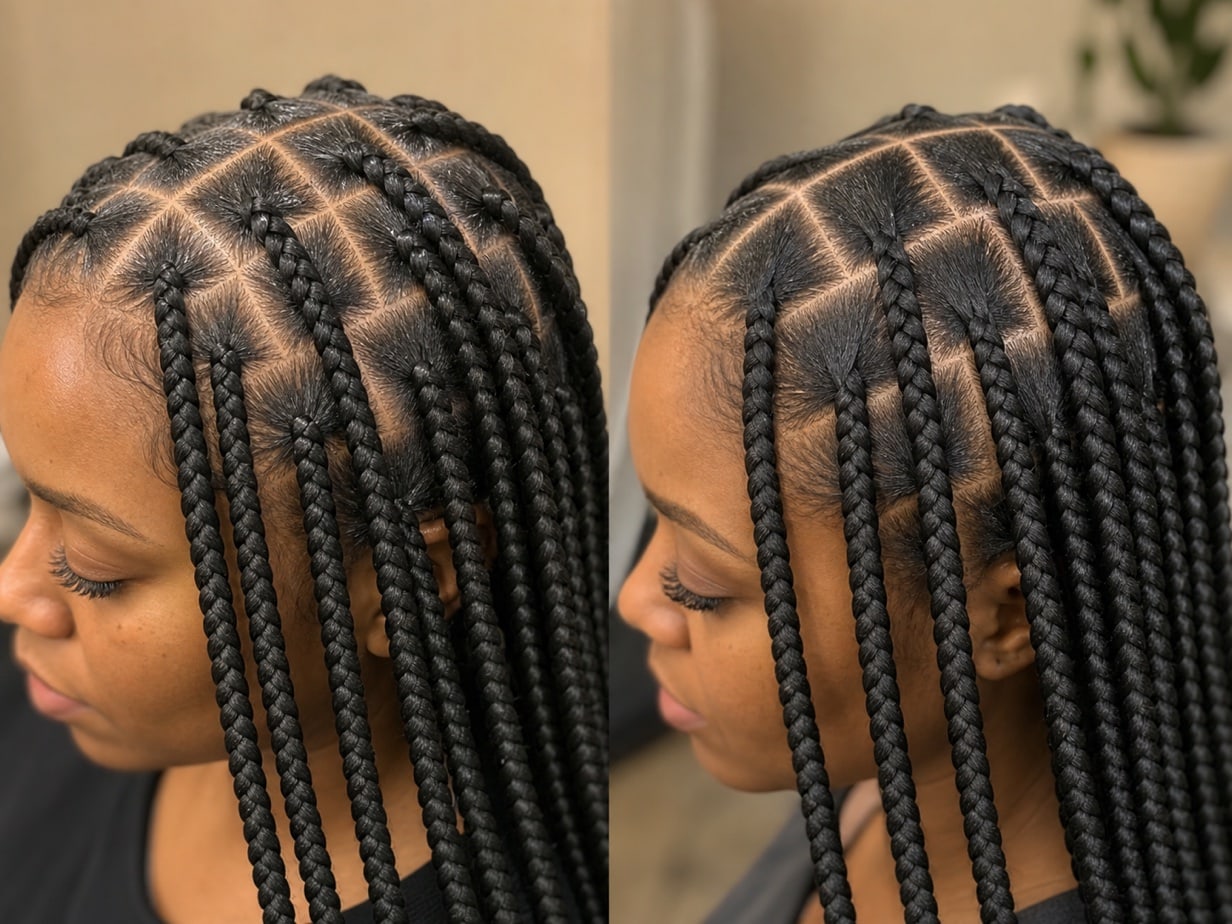
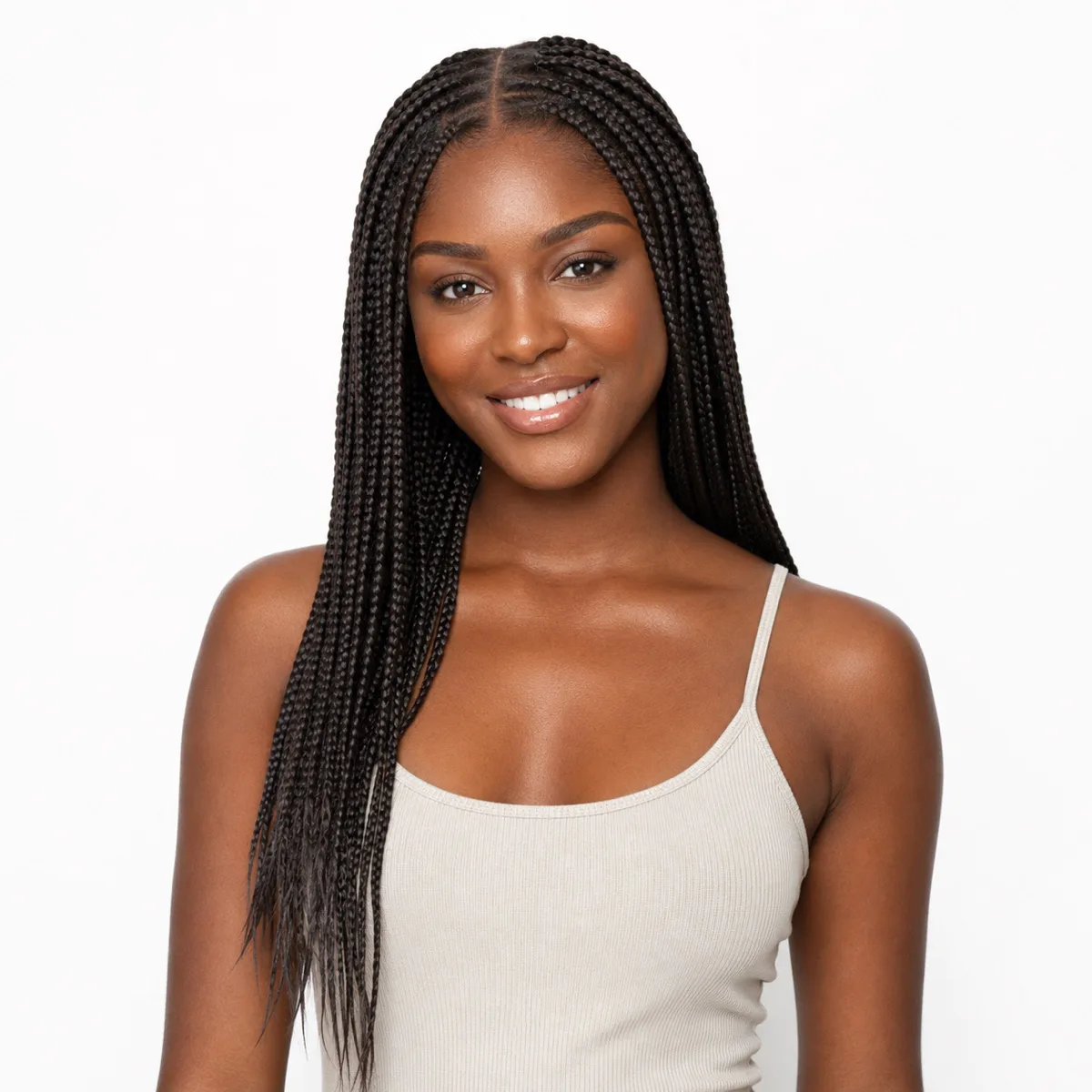
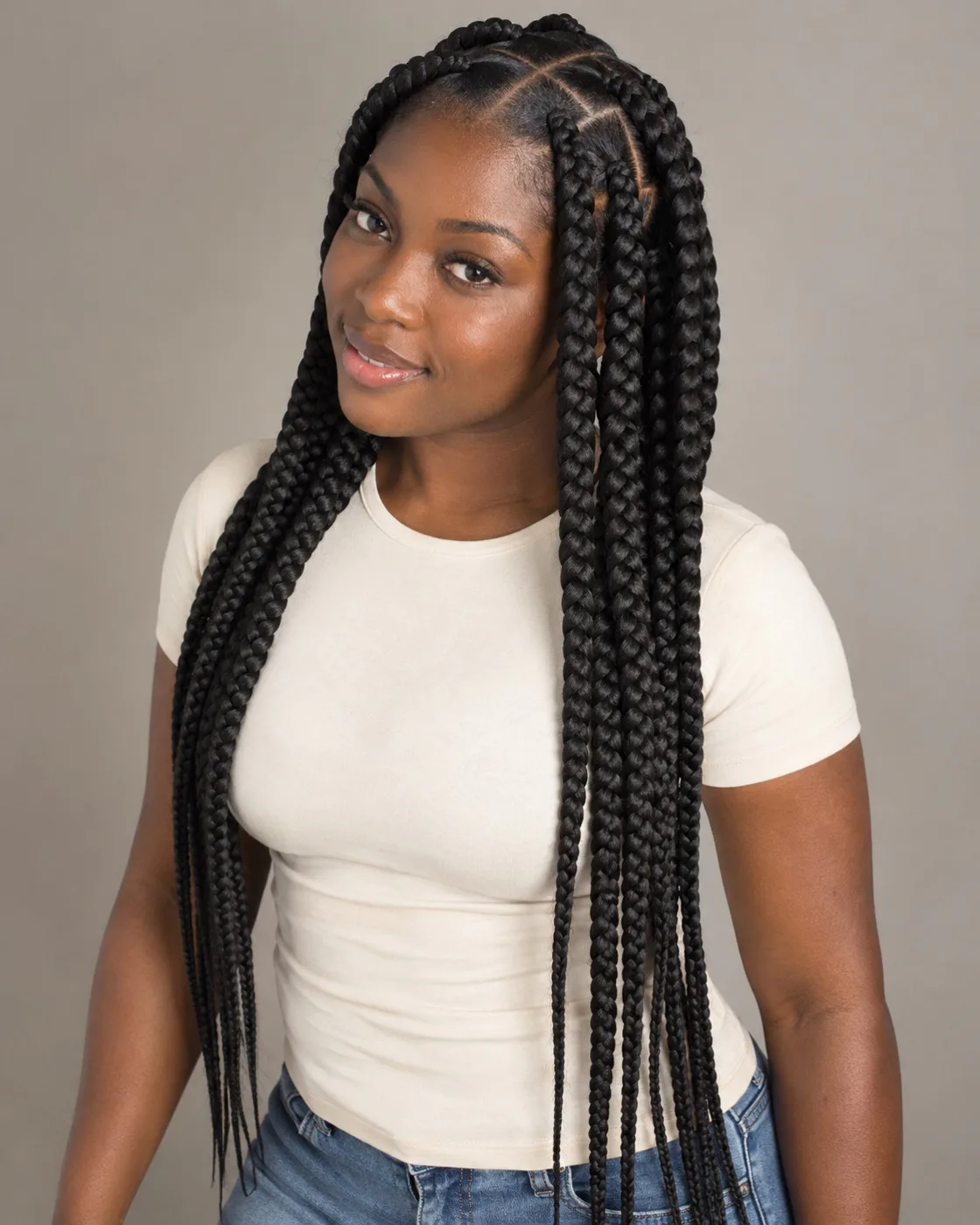
Illustrative comparison: an individual braider's parting and feed-in technique will change the exact root shape.
Knotless vs. box braids quick decision table
Use this table to choose by priority rather than by trend.
| Decision factor | Knotless braids | Traditional box braids |
|---|---|---|
| Root appearance | Flatter, more seamless, natural-hair start | More defined, slightly raised, structured base |
| Day-one movement | Usually flexible sooner | May feel firmer until the roots relax |
| Scalp comfort | Often the better starting point for a sensitive scalp | Can be comfortable when installed with a loose, controlled grip |
| Edge control | Easier to request a light feed-in or leave delicate edges out | Requires extra care so the root knot does not grip fine edge hairs |
| Root neatness over time | Natural hair at the base may show frizz or growth sooner | Anchored roots may keep a sharper sectioned look longer |
| Appointment time | Often longer because hair is fed in gradually | Often faster, although size and length can reverse this |
| Price | Often higher because the technique takes more time | Often lower, but pricing varies by salon and region |
| Immediate updos | Usually easier because the roots move more freely | High buns or ponytails may feel tight during the first few days |
| Best visual fit | Soft, flat roots and flowing movement | Bold sections and a more sculpted braided look |
| Main caution | Small sections or heavy length can still create tension | A tight anchored base can concentrate pulling at the root |
Choose knotless braids if
- You have a sensitive scalp or dislike a stiff first week.
- You want the braids to lie flatter around a middle or side part.
- You regularly wear the braids down or move them from side to side.
- You want a softer transition between your natural hair and the extension hair.
- You are willing to spend more appointment time for a gradual feed-in installation.
Choose traditional box braids if
- You like a crisp, structured root and clearly visible parts.
- You want the base to resist early fuzziness as much as possible.
- Appointment time or budget is a stronger constraint.
- Your braider consistently installs traditional bases without pain or excessive grip.
- You prefer a firmer root and do not need an immediate high ponytail.
Which style puts less tension on the scalp?
Knotless braids usually spread the added hair more gradually, so they can reduce the concentrated pull created by a bulky knot at the root. That makes them a sensible starting point for someone who has previously found traditional box braids uncomfortable.
The technique is not a guarantee. A knotless set can still be too tight when:
- the natural-hair starter braid is gripped aggressively;
- tiny sections are asked to carry long or thick extensions;
- too much added hair is fed into each section;
- the edges are forced into the braid;
- the finished braids are repeatedly pulled into tight buns or ponytails.
The American Academy of Dermatology warns that repeatedly tight braids and extensions can contribute to traction alopecia. Its practical signal is simple: if a hairstyle feels painful, it is too tight. The AAD also recommends loosening braids around the hairline, choosing thicker braids, limiting extra length and weight, and changing a style when pain, stinging, crusting, scalp tenting, broken edge hairs, or a receding hairline appear.
St George's University Hospitals' guide to Afro-textured hair adds two useful details. Extension length and decorations add weight, and larger sections generally place less stress on the hair unless the extensions themselves are heavy. In other words, a medium knotless set with waist-length, dense extensions may pull more than a lightweight shoulder-length traditional set.
A better scalp-comfort order
When comfort is the priority, make decisions in this order:
- Choose an experienced braider who will redo a painful section.
- Protect the edges with larger sections, a lighter grip, or an intentional leave-out.
- Select medium or large braids before committing to small or micro braids.
- Keep the length and amount of added hair moderate.
- Decide between knotless and traditional installation.
- Avoid tight updos during wear.
This order matters because switching to knotless braids cannot compensate for excessive weight or a tight natural-hair starter braid.
Which style usually lasts longer?
Traditional box braids often keep a more defined root for longer because the extension hair is secured at the base. Knotless braids begin with exposed natural hair, so new growth and root frizz can become visible sooner. That does not always mean the knotless set must come out sooner. It may simply look softer at the scalp.
Hair.com gives a typical comparison of roughly four to six weeks for knotless braids and up to around eight weeks for traditional box braids with proper care. Treat those numbers as broad salon guidance, not a deadline. Hair growth, braid size, scalp oil, exercise, washing, sleep protection, extension weight, and edge condition all change the useful wear period.
For scalp and hair health, appearance should not be the only rule. The AAD recommends wearing braids or locs for no longer than six to eight weeks, while the St George's NHS guide advises not leaving braids in longer than six weeks. A practical plan is to book a four-to-six-week check or takedown window and remove the style earlier if the roots mat, buildup becomes difficult to clean, the braids pull, or the edges show breakage.
What actually helps braids look good longer
- Start with clean, conditioned, fully detangled hair.
- Use a part size that can support the extension weight.
- Sleep with a satin or silk scarf, bonnet, or pillowcase.
- Clean the scalp gently instead of layering oil over buildup.
- Keep heavy products off the braid roots.
- Avoid repeatedly pulling the full set into the same tight position.
- Accept a little natural root softness instead of trying to retighten the hairline.
Installation time and cost
Knotless braids commonly take longer because the braider must start each section with natural hair and add extension hair in controlled increments. Traditional box braids can be faster because the extension hair is anchored at the beginning of each braid.
Do not book from the method name alone. Ask the braider for an estimate based on:
- braid size;
- finished length;
- number of braiders working;
- parting complexity;
- whether hair is supplied;
- whether washing, blow-drying, or trimming is included;
- whether curls, beads, or color blending are added;
- whether takedown is a separate service.
The same factors control price. A small waist-length traditional set can cost more and take longer than a medium shoulder-length knotless set. Compare the exact service, not a generic "knotless costs more" rule.
A salon estimate that is actually useful
Send one front reference, one back reference, and your desired length. Then ask:
"For medium braids at this length, what is the expected appointment time and total price? Is the hair included, and would knotless or traditional installation change the estimate?"
That question gives the braider enough information to answer without guessing.
Choose size and length before you book
Size and length shape the experience more than most people expect. They influence weight, part visibility, appointment time, styling options, drying time, root frizz, and removal.
| Choice | What it changes | Good fit | Main tradeoff |
|---|---|---|---|
| Large or jumbo braids | Fewer sections, bolder shape, shorter appointment | Statement look, shorter wear plan, lower section count | Each braid can become heavy if too much hair is added |
| Medium braids | Balanced section count and movement | First-time box braids, everyday styling, easier comparison | Still requires a deliberate length and weight limit |
| Small braids | More movement and a fuller curtain of braids | Detailed look, flexible parting, people comfortable with long appointments | More sections, longer installation, smaller anchors |
| Shoulder to mid-back length | Moderate movement and easier daily handling | Work, exercise, sensitive scalp, first set | Less dramatic than waist or hip length |
| Waist or hip length | Strong visual impact and more styling range | Occasional statement style with a weight-aware plan | More weight, more drying time, more pull in updos |
If you are undecided, choose medium braids between shoulder and mid-back length. That combination gives enough movement to judge the style without beginning with the heaviest or most time-consuming version.
Parting changes the look too. Square parts feel classic and geometric. Triangle parts add a more decorative root pattern. Organic or brick-layered parts can reduce obvious scalp lines and make the braids fall more naturally. Decide whether you want the parts to be a feature or simply the structure beneath the style.
For a wider survey of braid layouts, compare HairWow's guide to different braid hairstyles and the Black braided hairstyles guide. If you are considering only a few large sections, the four braids guide explains how section count changes the result.
What to tell your braider
A useful braid brief covers six decisions:
- Installation: knotless feed-in or traditional anchored base.
- Size: large, medium, small, or a reference showing the exact scale.
- Length: shoulder, bra-strap, mid-back, waist, or another clear endpoint.
- Parting: square, triangle, brick-layered, organic, center part, or side part.
- Weight: how much extension hair you are comfortable carrying.
- Edges: whether they should be loosely included, left out, or handled with larger sections.
Use wording like this:
"I want medium knotless braids that finish at mid-back. Keep the feed-in light, make the edge sections larger, and do not braid through pain. I want a center part with brick-layered sections in the back."
For traditional box braids:
"I want medium box braids with clean square parts and a structured root, but no tight knots around the hairline. Keep the added hair moderate and the finished length at the shoulder blades."
During installation, speak up when a single section hurts. Asking for one braid to be redone is easier than trying to tolerate a painful hairline for days.
How to care for either braid method
The care routine is nearly the same for knotless and traditional box braids. The goal is a clean scalp, low friction, controlled weight, and a takedown before the natural hair begins to mat at the root.
During the first two days
- Do not use a tight bun to force new braids into position.
- If a section causes pain, stinging, or a headache, contact the braider and have it loosened.
- Avoid trying to "calm" excessive tension with pain medicine or heavy oil.
Each week
- Check the hairline and parts for bumps, broken hairs, redness, or visible pulling.
- Clean the scalp gently with a mild shampoo method that works for you, then dry the roots thoroughly.
- Use only enough light leave-in or scalp product to address real dryness.
- Protect the braids at night to reduce friction and fuzz.
Before removal
- Set aside enough time to work slowly.
- Confirm where your natural hair ends before cutting extension length.
- Detangle shed hair section by section rather than pulling through a compact root.
- Cleanse and condition after the braids are fully removed.
- Give sore, broken, or thinning areas a break from tension.
If you notice continuing pain, scalp lesions, or thinning around the hairline, remove the source of tension and consult a board-certified dermatologist. Hair loss has multiple causes, so a photo or hairstyle label cannot diagnose the problem.
Where HairWow fits
HairWow helps with the visual part of the decision: braid length, overall volume, part direction, color, and how a braided silhouette frames your face. Use HairWow Try-On with a clear front-facing photo, then compare a shoulder-length option with a longer set before you book.
The preview is best used as a communication reference, not as a promise of exact braid construction. It cannot show how tightly a section will be installed, how much extension hair the braider will add, or how your scalp will respond. Pair the preview with the six-part salon brief above.
If you are unsure whether your hair is ready for a long-wear style, use Hair Analyze as a starting point for condition and routine questions, then discuss active breakage, scalp symptoms, or hair loss with an appropriate professional.
Frequently asked questions
Are knotless braids the same as knotless box braids?
Usually, yes. "Knotless braids" commonly refers to individual box-style braids that start with natural hair and feed in extension hair gradually. The parts do not have to be square, so the finished set may use triangle, rectangular, or organic sections.
Are knotless braids always better for your edges?
No. Knotless installation can reduce the bulky anchored knot at the root, but the starter braid, section size, extension weight, and edge handling still control tension. Request larger edge sections, a lighter grip, less added hair, or leave-out when needed.
Do knotless braids get frizzy faster?
They can show root frizz or new growth sooner because natural hair begins the braid at the scalp. Traditional box braids may retain a sharper base longer. Night protection, gentle cleansing, braid size, hair texture, and installation quality all affect how quickly the roots soften.
Which method is better for thin or fine hair?
Start by reducing weight rather than relying only on a technique label. Medium or large sections, shorter length, modest added hair, and gentle edge handling are sensible priorities. Knotless installation may create a lighter-looking base, but a professional should assess whether the natural hair can support extensions.
Can I put fresh box braids in a high ponytail?
Knotless braids usually move more easily right away. Traditional roots may feel firmer at first. With either method, avoid forcing a painful ponytail or bun during the first few days. Choose a loose, low position instead, and loosen any style that pulls at the hairline.
How long should I keep knotless or box braids in?
Plan around four to six weeks and assess the scalp, edges, buildup, root matting, and extension weight. Remove the style sooner if it hurts or causes visible pulling. AAD guidance gives six to eight weeks as an upper limit for braids or locs, while the St George's NHS guide recommends no longer than six weeks.
Which braids are faster to remove?
Knotless braids may be easier at the root because there is no anchored extension knot, but size and length have a bigger effect on total takedown time. Small, long braids create more work regardless of installation method. Plan enough time to detangle shed hair gently after each braid is removed.
Summary
Choose knotless braids when you want flatter roots, quicker day-one movement, and a lower-tension starting point. Choose traditional box braids when you prefer a crisp anchored base, potentially longer-looking root neatness, and often a shorter or less expensive appointment.
Then check the variables that matter more than the name: section size, added-hair weight, finished length, edge tension, and the braider's willingness to redo a painful section. Medium, moderate-length braids are the safest first comparison for many people because they balance movement, weight, styling range, and appointment time.
Preview the silhouette, bring front and back references, and give your braider a specific brief. Most importantly, do not treat pain as part of the process.