Curly Hair Routine: A Practical Plan for Defined Curls
Build a curly hair routine that covers wash day, styling, drying, sleep protection, refresh days, frizz control, and haircut choices before changing your curls.

· 15 min read

On this page
A good curly hair routine is simple enough to repeat and specific enough to match your curl pattern, density, dryness level, and haircut. Start with gentle cleansing, enough conditioner, styling product on damp hair, low-friction drying, sleep protection, and a light refresh plan for the next few days.
The goal is not to buy every curl product. The goal is to understand what your hair needs on wash day, what it can handle without getting weighed down, and when frizz is a sign of dryness, friction, buildup, or a haircut that no longer supports the curl shape. If you are also thinking about changing your layers, length, or fringe, preview the direction in HairWow's AI hairstyle try-on before you cut.
Quick Answer
For most curly hair, the safest routine is:
- Cleanse the scalp gently.
- Condition the lengths and detangle with slip.
- Apply leave-in, curl cream, or gel while the hair is still damp.
- Scrunch or smooth product through the curl pattern.
- Dry with a microfiber towel, cotton T-shirt, air drying, or a diffuser on low heat.
- Sleep with low friction.
- Refresh with water, a light leave-in mist, or a small amount of gel.
If your curls look frizzy on day one, adjust wash-day hydration and styling. If they look good on day one but collapse by day two, adjust hold, drying, sleep protection, or haircut shape. If they always look uneven, your cut may need curl-aware layering rather than more product.
What Makes Curly Hair Different?
Curly hair bends, coils, and changes direction along the strand. That shape makes natural scalp oil travel less evenly from root to end, so many curly hair types feel dry through the mid-lengths and ends even when the scalp is not dry.
The American Academy of Dermatology notes that curly hair is more likely to become dry and fragile, which is why gentle handling and conditioning matter. This affects every step of the routine: cleansing, detangling, drying, brushing, and sleeping.
Your routine should answer four questions:
| Question | Why it matters | Routine decision |
|---|---|---|
| How dry are the ends? | Dry ends frizz and lose shape faster | More conditioner, leave-in, or oil at the ends |
| How easily does the hair get weighed down? | Fine curls can collapse under heavy cream | Lighter leave-in, mousse, or small product amounts |
| How much hold do you need? | Humidity and movement break weak casts | Gel, mousse, or stronger styling hold |
| How does your haircut support the curl? | Shape affects volume, shrinkage, and frizz | Layers, length, fringe, and face framing |
Step 1: Cleanse the Scalp Without Roughing Up the Ends
Cleanse the scalp first. The scalp produces oil and collects sweat, product, and environmental buildup. The ends usually need less scrubbing. Work cleanser at the roots with your fingertips, not your nails, then let the rinse move through the lengths.
Choose the cleanser based on what your hair is doing:
| Hair behavior | What it may mean | Cleansing choice |
|---|---|---|
| Roots feel oily but ends feel dry | Scalp needs cleaning, ends need protection | Gentle shampoo at the scalp only |
| Curls feel coated or limp | Product buildup | Clarifying wash occasionally |
| Hair feels squeaky and rough after every wash | Cleanser may be too stripping | Gentler shampoo or fewer harsh washes |
| Scalp feels itchy or flaky | Scalp issue, not just curl shape | Consider dermatologist guidance |
Do not scrub the hair into a pile on top of your head. That creates tangles and friction. Keep the hair falling in its natural direction while you cleanse.
Step 2: Condition and Detangle With Slip
Conditioner is the part of the routine that gives curls enough slip to detangle without tearing. Apply it from mid-lengths to ends first. If your scalp is dry, you may use some near the roots, but many people need the most conditioner where the hair is older and more fragile.
Detangle when the hair has conditioner in it. Use your fingers or a wide-tooth comb, starting from the ends and moving upward. Rushing this step can cause breakage, especially on tighter curls and coils.
If your hair is very dense, section it. A four-section routine is often easier than trying to detangle the whole head at once.
Step 3: Decide What Styling Product Your Curls Need
Product choice should come from the result you want, not from product names alone.
| Product type | What it does | Best for |
|---|---|---|
| Leave-in conditioner | Adds softness and light moisture | Dry curls, coarse curls, ends that frizz early |
| Curl cream | Adds shape and softness | Medium to coarse curls, curls that need clumping |
| Mousse | Adds light hold and volume | Fine curls, waves, roots that collapse |
| Gel | Adds stronger hold and humidity defense | Frizz-prone curls, longer-lasting definition |
| Oil or serum | Adds finish and reduces surface friction | Dry ends, breaking gel cast, final polish |
For many people, one leave-in plus one hold product is enough. Too many layers can make curls dull, sticky, or heavy.
Apply product while the hair is damp or wet. Curly hair usually forms better clumps when product is added before the hair starts to dry. If the hair is already drying unevenly, mist it with water before styling.
Step 4: Use the Right Styling Method
The method matters as much as the product. Try one of these approaches:
| Method | How it works | Best for |
|---|---|---|
| Praying hands | Smooth product between palms down the hair | Reducing frizz and coating the surface |
| Raking | Finger-comb product through sections | Separating dense curls and distributing product |
| Scrunching | Lift ends upward and squeeze | Encouraging curl shape and bounce |
| Finger coiling | Twist small pieces around a finger | Fixing uneven front pieces or face framing |
| Brush styling | Use a styling brush to define sections | More polished curl clumps |
If you want volume, avoid packing too much product directly at the root. If you want less frizz, avoid breaking the curl clumps too early.
Step 5: Dry With Less Friction
Drying is where many curly routines fall apart. A rough towel can disrupt the curl pattern before the products set. Use a microfiber towel or a soft cotton T-shirt, then squeeze instead of rubbing.
You can air dry or diffuse. Air drying is gentle but can take a long time. Diffusing is faster and can create more volume, but heat and rough handling can cause frizz. Use lower heat, lower airflow, and avoid moving the diffuser constantly.
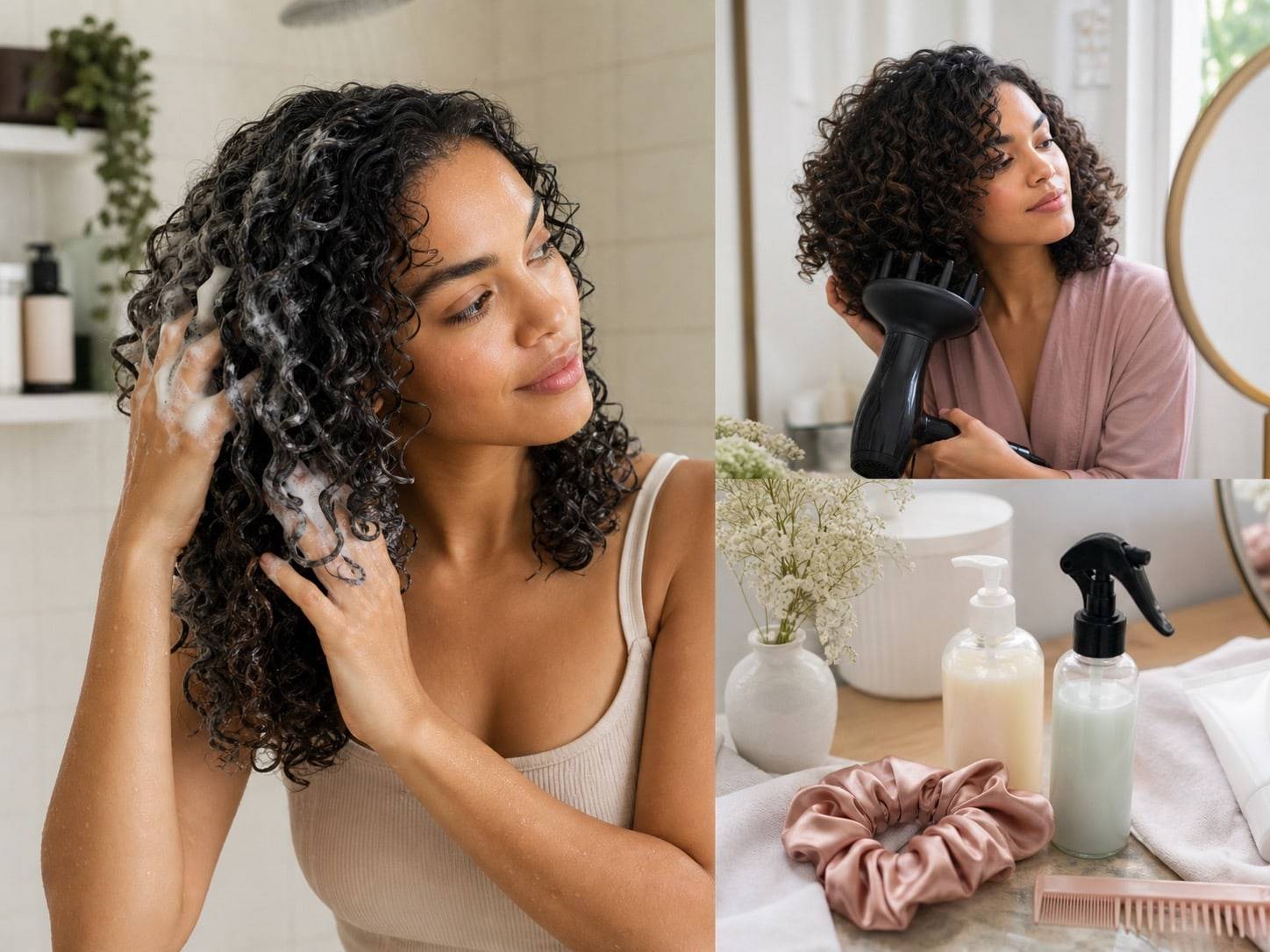
Let the hair dry fully before touching it too much. If you use gel, the hair may feel slightly firm while it dries. Once it is dry, gently scrunch to soften the cast.
Step 6: Protect Curls While You Sleep
Good wash-day styling can still fail overnight if the hair rubs against cotton bedding for eight hours. Friction can flatten curls, create halo frizz, and make the front pieces look uneven.
Try one or more of these:
| Sleep habit | What it helps |
|---|---|
| Satin or silk pillowcase | Reduces friction |
| Loose pineapple | Keeps curls lifted away from the neck |
| Satin bonnet or scarf | Protects the full curl pattern |
| Loose scrunchie | Avoids tight dents |
| Dry hair before bed | Prevents stretched, crushed, uneven curls |
Avoid sleeping with wet curls if you can. Wet hair is more fragile, and pressure can set the hair into a shape you do not want.
Step 7: Refresh on Day Two and Day Three
Refresh days should be lighter than wash day. If you add the same amount of cream every morning, the curls may get sticky or heavy.
Start with water. Mist the flattened sections and let them reactivate. Then choose the smallest useful product amount:
| Refresh problem | Try this |
|---|---|
| Curls are flat but not dry | Water mist and scrunch |
| Ends are dry | Tiny amount of leave-in on the ends |
| Halo frizz | Wet hands with a small amount of gel and smooth the surface |
| Front curls look uneven | Finger coil only the pieces that need help |
| Roots are oily | Refresh the ends, then plan a scalp cleanse soon |
Do not force every curl to look like wash day. The second day can look softer. The goal is controlled shape, not perfect uniformity.
How Often Should You Wash Curly Hair?
There is no universal schedule. Some people wash every two or three days. Others wash weekly. The right schedule depends on scalp oil, exercise, product buildup, curl tightness, weather, and personal comfort.
Use these signs:
| If you notice | Your routine may need |
|---|---|
| Itchy or oily scalp | More frequent cleansing |
| Dull curls with flakes of product | Clarifying wash |
| Dry ends after every wash | Gentler cleansing or richer conditioner |
| Curls fall flat quickly | Lighter products or stronger hold |
| Hair breaks when detangling | More slip and slower detangling |
Healthy hair routines are scalp routines too. If your scalp is irritated, painful, flaky, or shedding more than usual, treat that as a health signal rather than a styling inconvenience.
Match the Routine to Your Curl Type
Curl type can help, but it should not be the only rule. Density, porosity, length, climate, and haircut can matter just as much.
| Curl pattern | Routine starting point |
|---|---|
| Wavy hair | Lightweight leave-in, mousse, careful scrunching, less heavy cream |
| Loose curls | Leave-in plus light gel or cream, diffuse for volume if needed |
| Springy curls | More conditioner, curl cream or gel, sectioned styling |
| Coils | Richer conditioning, careful detangling, more sectioning, protective sleep habits |
| Mixed texture | Treat each section differently instead of forcing one rule |
If the crown is flatter than the sides, use less product near the root and diffuse upside down or side to side. If the ends puff out, they may need more hydration, a trim, or a curl-aware cut.
When the Problem Is the Haircut, Not the Routine
Products cannot always fix shape. A haircut that is too blunt, too heavy, or too thinned out can make curls harder to style.
Consider a cut adjustment if:
- The top is flat but the sides are wide.
- The bottom forms a triangle shape.
- The front pieces spring much shorter than the rest.
- The curls look good only when pinned back.
- The ends are stringy even after conditioning.
- The routine works for one week after a trim, then quickly falls apart.
Curly hair often needs shaping that accounts for shrinkage. If you are choosing layers, bangs, or a shorter shape, compare visual directions before cutting. HairWow can help you preview whether your face looks better with short curls, long waves, curl-friendly layers, or more volume.
Routine Examples
Simple Curly Routine for Beginners
Use this if you want the fewest steps:
| Step | What to do |
|---|---|
| Cleanse | Gentle shampoo at the scalp |
| Condition | Conditioner through lengths, detangle slowly |
| Style | Leave-in plus gel on damp hair |
| Dry | Microfiber towel, then air dry or low diffuser |
| Sleep | Satin pillowcase or loose pineapple |
| Refresh | Water mist and a small amount of gel |
Routine for Frizz-Prone Curls
Use this if curls frizz before they define:
| Step | Adjustment |
|---|---|
| Cleanse | Avoid stripping the ends |
| Condition | Let conditioner sit longer before detangling |
| Product | Apply while hair is wetter |
| Hold | Add gel for a stronger cast |
| Dry | Do not touch until fully dry |
| Sleep | Cover or lift curls before bed |
For more frizz-specific troubleshooting, read our frizzy hair routine guide.
Routine for Fine Curly Hair
Fine curls need definition without weight:
| Step | Adjustment |
|---|---|
| Conditioner | Use enough slip, but rinse thoroughly |
| Styling | Mousse or light gel before heavy cream |
| Roots | Keep product light near the scalp |
| Drying | Diffuse for lift |
| Refresh | Use water first, not more cream |
Routine for Dense Curly Hair
Dense curls need sectioning:
| Step | Adjustment |
|---|---|
| Cleansing | Work in sections so the scalp gets clean |
| Conditioning | Detangle in sections |
| Styling | Apply product section by section |
| Drying | Expect longer dry time |
| Refresh | Fix only the outer and front pieces if the inside holds shape |
Common Curly Hair Routine Mistakes
Using Too Much Product Too Soon
If your curls feel coated or look dull, reduce the amount before you buy something new. A small amount spread evenly is usually better than a large amount sitting on the surface.
Brushing Dry Curls
Dry brushing can separate curl clumps and create a frizzy outline. If you need to reshape curls, mist them first or detangle before styling.
Skipping Hold
Moisture alone may make curls soft, but it may not keep shape through humidity, sleep, and movement. If your curls look good wet and frizzy dry, you may need more hold.
Cutting Without Planning Shrinkage
Curly hair can look much shorter once dry. Bangs, face-framing pieces, and short layers need extra planning. Preview shorter shapes and ask your stylist how they account for shrinkage.
Treating Every Curl the Same
Many people have tighter curls near the face, looser curls at the crown, or different textures underneath. Use different product amounts and styling methods where needed.
What to Ask Your Stylist
Bring clear wording, not just a photo:
- "My main goal is curl definition with less triangle shape."
- "Please account for shrinkage before cutting the front pieces."
- "I want layers that support curl clumps, not thin out the ends."
- "Can we keep enough length for my curl pattern to spring back?"
- "Which pieces should I style forward, and which should fall away from my face?"
- "How should I refresh this cut on day two?"
If you are unsure whether to go shorter, start with a more conservative trim and routine adjustment. You can cut more later, but you cannot immediately recover from layers that spring too high.
Curly Hair Routine Checklist
Before you change products, check the basics:
| Routine area | Good sign | Needs adjustment |
|---|---|---|
| Cleanse | Scalp feels clean, ends do not feel stripped | Roots oily, ends rough |
| Condition | Hair detangles with less pulling | Knots, snapping, rough ends |
| Styling | Product spreads evenly | Sticky patches or dry frizz |
| Drying | Curl clumps stay intact | Halo frizz from rubbing or touching |
| Sleep | Curls survive overnight | Flat crown, fuzzy front pieces |
| Haircut | Shape supports your natural pattern | Triangle shape, heavy ends, uneven shrinkage |
FAQ
What is the best routine for curly hair?
The best routine is the simplest routine that keeps your scalp comfortable, your curls defined, and your ends from drying out. Most people need gentle cleansing, conditioner, a styling product on damp hair, low-friction drying, sleep protection, and light refresh steps.
Should curly hair be styled wet or damp?
Most curly hair styles better while wet or damp because product spreads more evenly and curl clumps form before the hair dries. If your curls are fine and get weighed down, try damp styling with lighter product.
Is gel bad for curly hair?
Gel is not automatically bad. It can help curls hold shape and resist humidity. The issue is using too much, not washing buildup when needed, or choosing a gel that makes the hair feel brittle.
How do I stop curly hair from getting frizzy overnight?
Reduce friction. Use a satin or silk pillowcase, loose pineapple, bonnet, or scarf. Make sure the hair is fully dry before sleep when possible.
How do I know if my curly hair needs protein or moisture?
If hair feels rough and dry, start by improving conditioning and reducing friction. If hair feels mushy, overly soft, and will not hold shape, it may need more structure. When in doubt, change one step at a time so you can tell what helped.
Can HairWow show me a curly haircut before I cut it?
Yes. HairWow can help you preview curly directions such as short curls, long waves, glossy curls, curly shags, and face-framing layers on your own photo. Use it as a visual planning step before asking a stylist to change your length or layers.