Work Hairstyles for Long Hair: 12 Polished Options
See work hairstyles for long hair that look polished, stay comfortable, protect your hairline, and still feel realistic for busy mornings.
· 16 min read
On this page
The best work hairstyles for long hair are polished, stable, comfortable, and easy to reset during the day. For most workplaces, start with a low bun, low ponytail, half-up twist, low braid, soft clipped-back waves, or French twist. These styles keep hair away from your face without making the look feel stiff.
The right choice depends on your work setting, hair texture, face framing, and how much time you realistically have before leaving home. A style that looks perfect in a tutorial can still fail at work if it pulls at the hairline, slips by lunch, hides your face on video, or needs constant touch-ups.
Before you choose a new work look for an interview, presentation, client meeting, or office photo day, preview the shape in HairWow Try-On. Long hair can change your face more than expected when it is pulled back, parted differently, or lifted at the crown.
Key takeaways
- Low styles usually look more professional and hold better than high styles.
- A polished work hairstyle controls the crown, face frame, and ends.
- Sleek hair, waves, curls, and dense long hair need different grip and hold.
- Tight daily buns and ponytails can stress the hairline, so rotate styles.
- For interviews and presentations, choose a style you will not keep fixing.
- For video calls, keep both eyes and most of the face visible.
- A small clip, covered elastic, or simple pin set is often better than a dramatic accessory.
Definition: A work hairstyle for long hair is a practical style that manages length through a workday while matching the formality, movement, camera visibility, and comfort needs of the job.
Quick answer by workplace
| Work setting | Best long-hair styles | Avoid |
|---|---|---|
| Interview | Low bun, low ponytail, French twist | Styles that need mid-interview adjustment |
| Formal office | Sleek low bun, smooth low ponytail, side part ponytail | Messy topknots, loose front pieces that fall forward |
| Creative office | Half-up twist, claw clip twist, soft pinned waves | Overly tight styles that feel unlike you |
| Video calls | Low bun, half-up style, tucked waves | Hair covering one eye or one side of the face |
| Active workday | Low braid, braided ponytail, secure low bun | Loose hair that tangles or catches |
| Client-facing role | French twist, polished low ponytail, soft low chignon | Wet-look styling unless it fits the brand |
| Commute-heavy day | Low braid, claw clip twist, low ponytail | High tension buns that pull during travel |
| After-work event | Soft waves with pinned sides, low chignon, half-up twist | A style that cannot be refreshed quickly |
12 work hairstyles for long hair
1. Low bun
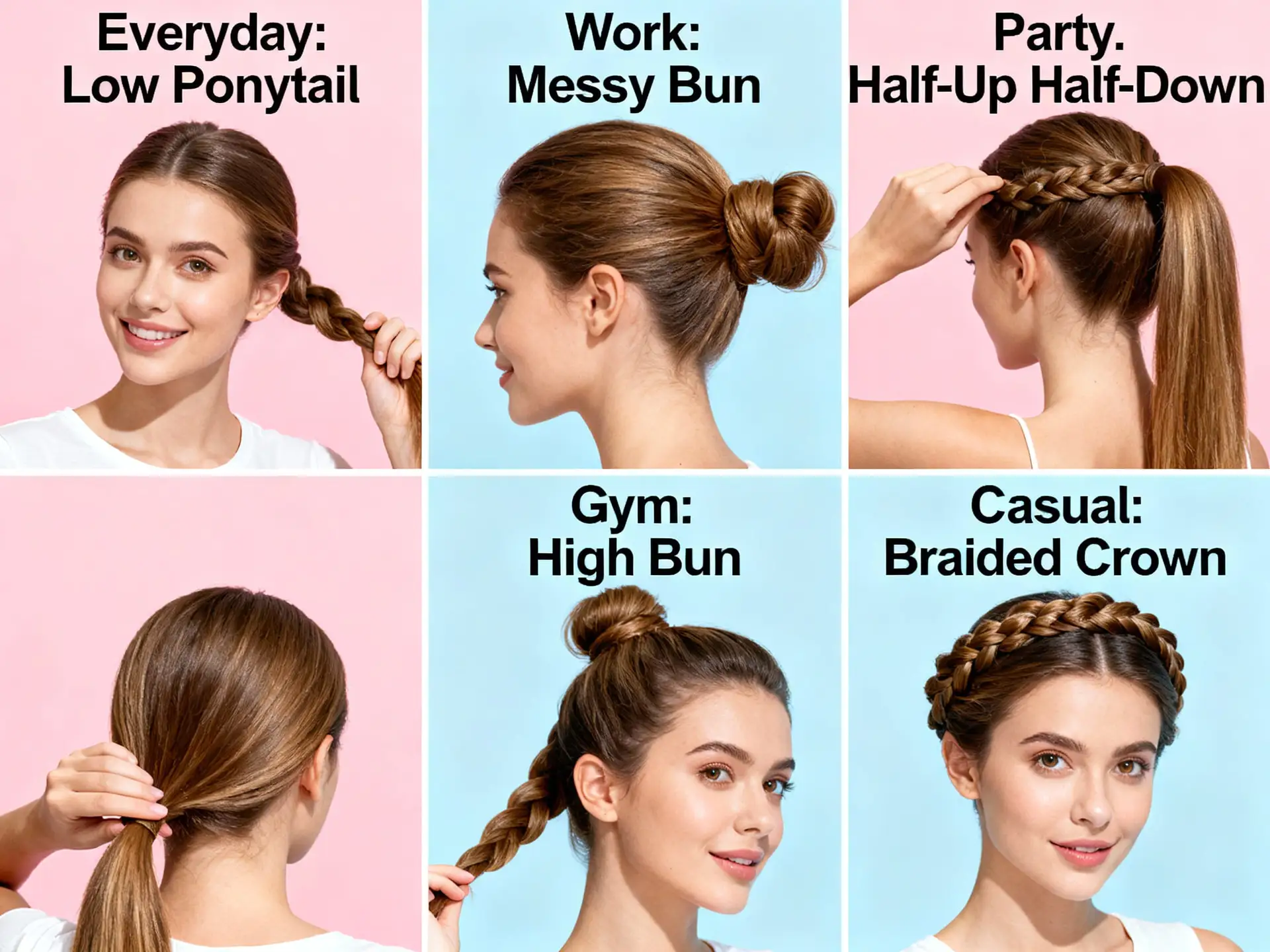
A low bun is the safest professional hairstyle for long hair because it looks intentional without needing drama. It works for interviews, formal offices, meetings, presentations, and days when you need your hair off your neck.
Keep the bun at the nape or just above it. A bun placed too high can read more casual, and a bun placed too low can loosen against a collar. For a softer face, leave two deliberate front pieces or use a side part instead of pulling everything straight back.
Best for: straight, wavy, medium, or thick long hair.
2. Smooth low ponytail
A low ponytail is fast, clean, and easy to redo in a restroom mirror. It works best when the crown is tidy and the elastic is covered with a small section of hair or a simple cuff.
For fine hair, add a small amount of root lift so the ponytail does not collapse. For thick hair, use two elastics or one stronger covered elastic. For curly hair, keep the ponytail loose enough that the curl pattern still looks intentional.
Best for: busy mornings, client meetings, straight hair, polished outfits.
3. Half-up twist
A half-up twist keeps hair away from the face while still showing length. It is a good middle ground when wearing all your hair up feels too severe, but wearing it down becomes distracting by noon.
The key is placement. Gather hair from the temple area, twist it back, and secure it slightly below the crown. If the twist sits too high, it can feel prom-like. If it sits too low, the front pieces may slide forward.
4. Claw clip twist
A claw clip can be professional if the clip is simple and the shape is neat. Choose matte, tortoise, black, brown, cream, metal, or a color that belongs with your outfit. Avoid oversized novelty clips for formal days.
For long hair, twist the length upward, fold the ends down, and clip vertically. If your hair is very long or heavy, use a large curved clip or anchor the twist with one pin before clipping.
Best for: casual offices, hybrid work, second-day hair, quick resets.
5. Low braid
A low braid is one of the most practical work hairstyles for long hair because it controls length and reduces tangles. It is especially useful for commuting, active jobs, windy weather, and days when you do not want hair touching your face.
Keep it polished by smoothing the crown first, braiding loosely enough to avoid scalp tension, and securing the end with a covered elastic. A center part looks clean. A side part looks softer.
Best for: long thick hair, wavy hair, textured hair, outdoor movement.
6. Braided ponytail
A braided ponytail gives the polish of a ponytail with better control over the length. It is useful when your hair is long enough to swing forward, catch on a strap, or tangle during the day.
Start with a low or mid ponytail, then braid the ponytail section. Keep the first elastic comfortable. A ponytail that is tight at the base can pull more than a normal braid.
Best for: dense long hair, active workdays, travel days.
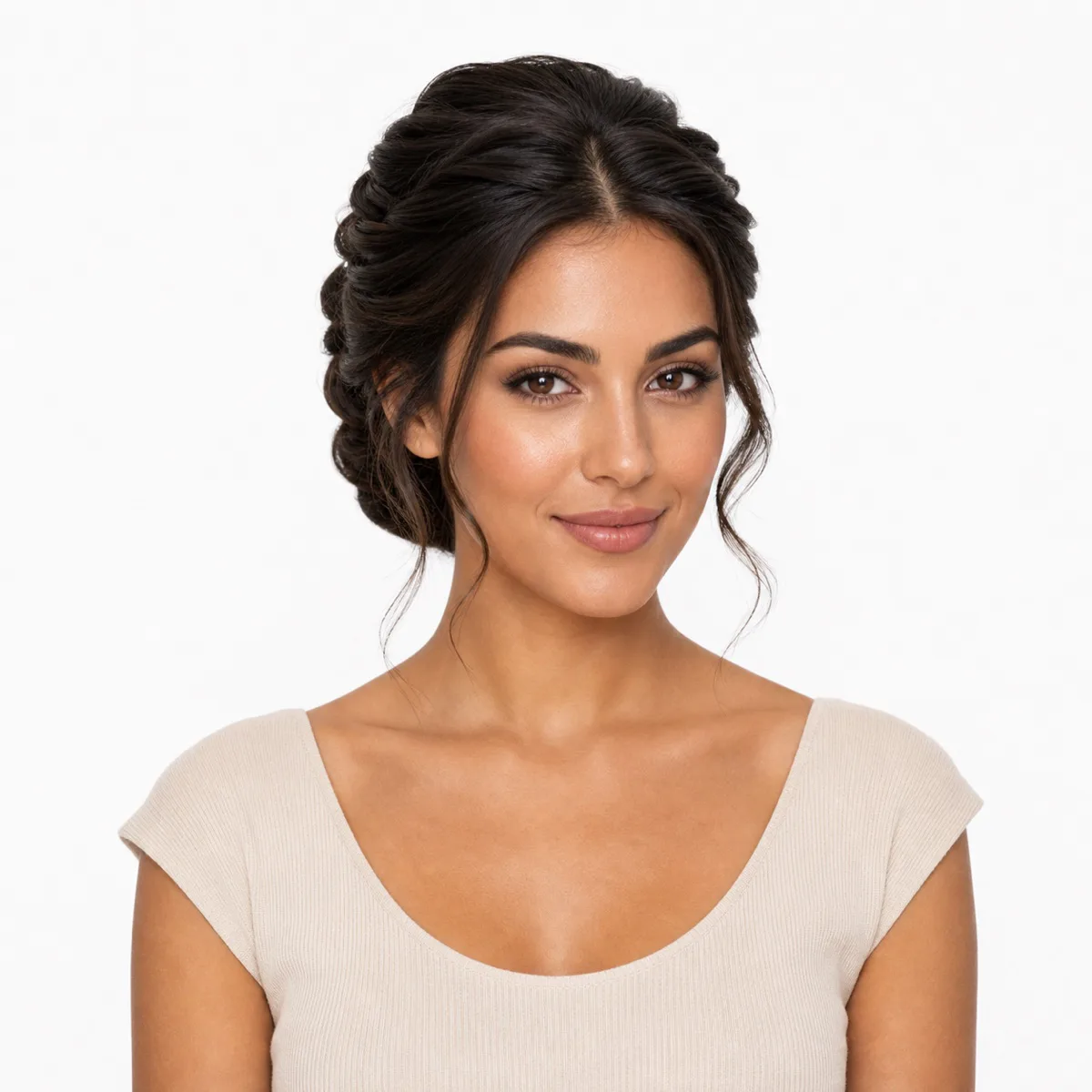
7. French twist
A French twist is a classic formal option for long hair. It works well for presentations, weddings, conferences, interviews, and office events where you want a more finished shape than a basic bun.
Modernize it by keeping the surface smooth but not shellacked. A small amount of softness at the front makes the style easier to wear. If your hair is slippery, add texture spray before twisting.
Best for: formal work settings, medium to thick hair, shoulder-length to long hair.
8. Soft waves with pinned sides
If you prefer wearing long hair down, pinning the sides keeps the style work-friendly. The hair still moves, but it does not cover your face on calls or fall into your eyes while typing.
Use two small pins, a hidden bobby pin, or a slim barrette. Place the pins just behind the temple rather than directly above the ear. That keeps the shape intentional instead of looking like a quick tuck.
Best for: presentations, creative offices, after-work plans.
9. Sleek middle part bun
A sleek middle part bun is minimal, modern, and direct. It works best when the outfit is also clean and structured. It can look severe on some faces, so test it before using it for an important meeting.
If a middle part exposes too much forehead or makes the jaw feel wider, soften the look with a slightly off-center part, a low side part, or a little crown lift.
Best for: formal offices, interviews, sharp tailoring, straight or smoothed hair.
10. Side part ponytail
A side part ponytail is softer than a center-part ponytail. It can balance round, square, or heart-shaped faces because the diagonal line breaks up symmetry.
Keep the ponytail low and the part clean. If your hair is layered, pin short front sections so they do not fall into your face during work.
Best for: face framing, medium formality, long layered hair.
11. Curly low puff or low curly ponytail
For curly long hair, a low puff or low curly ponytail can look polished while preserving texture. The goal is not to flatten the curls. The goal is to control the front and let the curl pattern stay visible.
Use a soft tie, satin scrunchie, or covered elastic. Avoid pulling the hairline tight. Smooth the front with water, leave-in conditioner, or a curl-friendly gel only where needed.
Best for: curly, coily, or textured long hair.
12. Tucked-behind-ears long hair
Sometimes the simplest work hairstyle is clean long hair tucked behind the ears. This works when the hair is freshly styled, the ends are healthy, and the cut already has a clear shape.
It is less reliable if your hair falls forward every few minutes. In that case, add hidden pins, a half-up twist, or a low ponytail.
Best for: long straight hair, clean layers, lower-formality settings.
How to choose by hair texture
| Hair texture | Work style that usually holds | What to adjust |
|---|---|---|
| Fine straight hair | Low ponytail, low bun, half-up twist | Add grip with dry shampoo or texture spray |
| Thick straight hair | Low braid, French twist, braided ponytail | Use stronger covered elastics and larger pins |
| Wavy hair | Soft pinned waves, low bun, half-up twist | Do not over-brush the wave into frizz |
| Curly hair | Low curly ponytail, loose bun, pinned sides | Keep tension low and refresh the front with water |
| Coily hair | Low puff, loose braid, protected updo | Avoid daily tight pulling at the hairline |
| Layered long hair | Half-up twist, side part ponytail | Pin short front pieces deliberately |
| Very long hair | Low braid, folded claw clip twist, braided ponytail | Anchor the weight before clipping |
How to choose by face shape
Face shape should not lock you into one hairstyle, but it can explain why a work style feels polished on one person and severe on another.
| Face shape or feature | Helpful work-hair adjustment |
|---|---|
| Round face | Add a little height at the crown or use a side part |
| Long face | Keep crown volume moderate and avoid very high buns |
| Square jaw | Try a side part, soft front pieces, or lower placement |
| Heart-shaped face | Keep a little softness near the cheekbones or jaw |
| Small forehead | Avoid heavy front pieces that crowd the face |
| High forehead | Try a side part, curtain pieces, or soft face framing |
| Strong cheekbones | A tucked style or low bun can show them cleanly |
| Sensitive hairline | Use loose low styles and rotate tension points |
Previewing helps here because the same bun can either open your face or make the forehead feel too exposed. Upload a front-facing photo to HairWow Try-On, compare a pulled-back updo with a softer layered direction, and choose the version that still looks like you.
How to make long hair look professional
Professional long hair is mostly about control. It does not have to be short, flat, or boring.
- Smooth the crown first.
- Decide the part before tying the style.
- Control the face frame.
- Hide or simplify the elastic.
- Keep the ends neat.
- Choose accessories that match the outfit.
- Make sure the style works from the side, not only the front.
- Check the style in the same lighting you use for video calls.
Small details matter. A low ponytail with a clean part can look more polished than a complicated updo with flyaways everywhere. A claw clip can work in a professional setting when the twist is tidy and the clip is understated.
Styles for interviews and presentations
For an interview, choose predictability over creativity. The best interview hairstyle for long hair is usually a low bun, low ponytail, French twist, or smooth half-up style. You should not need to touch it while answering questions.
For presentations, think about the audience's view. If you turn your head, does the hair fall forward? If you gesture, does the ponytail swing into your shoulder? If you are on camera, is one side of your face hidden?
Good interview and presentation rules:
- Keep hair away from both eyes.
- Avoid fresh experiments on the morning of the event.
- Use a style you have worn for at least one full day before.
- Keep accessories simple.
- Bring one spare elastic, two pins, and a tiny smoothing product if possible.
Hair health and tension warning
Long hair has weight, so work hairstyles can create repeated tension if you wear the same tight placement every day. The American Academy of Dermatology notes that tightly pulled buns, ponytails, braids, and updos can contribute to traction-related hair loss when repeated or worn too tightly.
That does not mean you should avoid updos. It means you should rotate where the tension sits.
| If you wore today | Try tomorrow |
|---|---|
| Tight low bun | Loose braid |
| Sleek ponytail | Half-up twist |
| High bun | Low claw clip twist |
| Braided ponytail | Soft pinned waves |
| Tight face-framing pins | Side part with fewer pins |
If your hairline feels sore, the style is too tight. If you see breakage around the temples, switch to looser placements, covered elastics, and styles that do not pull the same front sections every day. If you are unsure whether frizz, breakage, oiliness, or dryness is affecting your style, run Hair Analyze before changing every product at once.
Simple workday styling plan
Use this plan when you want a style that looks intentional but does not take 30 minutes.
Five-minute polished low bun
- Brush or finger-comb the crown into place.
- Set the part.
- Gather hair at the nape.
- Twist loosely into a bun.
- Secure with a covered elastic and pins.
- Smooth only the visible flyaways.
- Loosen the front if the face looks too severe.
Three-minute low ponytail
- Part the hair cleanly.
- Smooth the crown with your hands or a brush.
- Tie the ponytail low.
- Wrap a small strand around the elastic if you have time.
- Pin short layers that fall forward.
Two-minute reset
- Mist hands lightly with water.
- Smooth the crown and temples.
- Re-tie the base, not the whole style.
- Tuck loose front pieces behind the ear or pin them back.
- Leave the ends alone unless they are tangled.
What to avoid at work
- A style that feels tight within the first 10 minutes.
- Hair covering your eyes on calls or in client conversations.
- Accessories that make noise when you move.
- Very slippery clips that need constant resetting.
- Heavy oil near the face before a full day.
- Strong hold product that flakes when you touch it.
- A brand-new style for an interview morning.
- Pulling wet hair tightly into a bun and leaving it there all day.
The American Academy of Dermatology also advises gentle hair handling and limiting damaging habits. For work hair, that means avoiding unnecessary heat, minimizing harsh brushing, and using products that support the style without making hair brittle.
Salon and stylist notes
If your long hair never looks polished at work, the haircut may be doing too little. Ask your stylist for a shape that supports your daily styling, not only the way your hair looks in salon lighting.
Useful wording:
- "I wear my hair up for work most days. Please keep the front pieces long enough to tuck."
- "I need a low ponytail and low bun to look clean."
- "Please remove weight without creating short layers that pop out of updos."
- "I want face framing that can be worn down or pinned back."
- "Please show me where the shortest front layer will land when my hair is tied."
Avoid vague wording like "just make it easier." For long hair, easier might mean fewer layers, more layers, a cleaner perimeter, less bulk, or shorter face framing. Say how you actually wear it during work.
FAQ
What is the easiest professional hairstyle for long hair?
A low bun or low ponytail is the easiest professional hairstyle for long hair. Both are fast, stable, and work in most offices. The difference is mood: a bun feels more formal, while a low ponytail feels softer and easier to reset.
How do I stop long hair from looking messy at work?
Control the crown, part, face frame, and ends. A simple style looks polished when those areas are intentional. Use a covered elastic, a simple clip, and light smoothing only where flyaways are visible.
Are claw clips professional?
Claw clips can be professional if the clip is simple, the twist is neat, and the setting is not highly formal. For interviews, client meetings, or conservative offices, a low bun or low ponytail is usually safer.
What work hairstyle protects long hair?
A loose braid, low bun, low ponytail, or low claw clip twist can protect long hair better than wearing it loose all day. Rotate styles so the same hairline area is not pulled every day.
Should I wear long hair up or down for an interview?
Wear it in the style that keeps your face visible and needs the least fixing. For most interviews, a low bun, low ponytail, or smooth half-up style is safer than loose hair that falls forward.
How can I make a ponytail look professional?
Place it low, smooth the crown, use a clean part, and cover or simplify the elastic. If your layers fall forward, pin them deliberately instead of constantly tucking them behind your ear.
What should I keep at my desk for long hair?
Keep one covered elastic, two bobby pins, a small matte clip, and a travel-size smoothing product or brush. That is enough to reset most long-hair work styles without rebuilding everything.
Summary
The best work hairstyle for long hair is the one you can wear without touching it every 20 minutes. Start with a low, stable shape. Keep the face frame deliberate. Match the accessory to the workplace. Rotate styles to protect your hairline. If a pulled-back style feels too severe, compare it with softer face framing or long waves in HairWow before you choose the look for an important day.